The Sovereign Business

Why did you start your own business?
I’d wager that it wasn’t because you woke up one day and thought, "I want to be rich, so I’ll quit my job and start a company."
According to a 2025 report from Sellers Commerce, the most common reason for launching a business (cited by 57% of respondents) is wanting to be your own boss. It fulfills the American dream of being more independent.
There may be other motivations too—working better hours, building a legacy, pursuing your passion, or earning more money. But these motivations all have one thing in common: they offer you greater control over your life.
Another interesting statistic from the report is the top five challenges SMB owners face:
Inflation (24%), the quality of labor (21%), taxes (13%), cost of labor (9%), and government regulations (8%). Of these challenges, three (or arguably four) relate to policy outside of the control of business owners.
Yes, you can vote for one candidate or another, but politicians often don’t pay heed to the challenges of small businesses. They have bigger corporate donors to impress.
Do you sometimes pine for the simplicity of the past? I couldn’t imagine the hardware stores that supplied 19th-century pioneers and builders needed eighteen licenses and two accountants to figure out their taxes. They just ordered supplies and sold them.
This is to say that greater sovereignty over your affairs is generally what allows entrepreneurs and businesses to thrive. In this column, I want to share some of the key lessons from one of my favorite history books (written in 1997), which predicts many world events and changes we have already experienced.
I want to help individuals foster an independent mindset and apply it to their business, allowing them to finally achieve the control they desire. Read about The Sovereign Individual and become a Small Sovereign Business (SSB).
***
The Sovereign Individual
The Sovereign Individual: Mastering the Transition to the Information Age (1997) by James Dale Davidson and William Rees-Mogg is a book that analyzes societal shifts driven by technology and violence.
“When I think of having agency, controlling what I can in my life, the word sovereign comes to mind. Not at the nation-state level but at the individual level. Then, when thinking about how to apply agency and entrepreneurship to business in the 21st century, while acknowledging mega trends such as DX (digital transformation), all roads lead to Bitcoin.” Jeff Newman – CRO of Sovreign
The authors argue that human history progresses in epochs defined by the dominant means of power and production. These periods, lasting around 500 years, can be categorized as:
- The Agricultural Age – Societies organized around farming, land ownership, and feudal hierarchies. Power was exercised locally through monarchs, nobles, and clergy.
- The Industrial Age – Mass production, factories, and centralized nation‑states dominate. Economic power shifts to large corporations and governments that control physical capital and labor.
- The Information Age (the “Cyber‑Age”) – Knowledge, data, and digital communication become the primary drivers of wealth. Physical borders matter less; power begins to flow toward those who can manipulate information.
- The Sovereign‑Individual Age (the “Network‑Age”) —Individuals can command and protect their own digital assets, conduct business globally, and choose their own legal and fiscal jurisdictions. Authority moves from nation‑states to decentralized, network‑based structures.
Davidson and Rees-Mogg's chart also presents the Strauss-Howe generational theory, breaking these epochs down further and highlighting four distinct periods of change (lasting 80-100 years) from which we can extrapolate when the next societal shift will take place.
“We named our company Sovreign as a play on words of SOVreign, while sounding like, and conveying the idea of being sovereign. The idea is to have total control (reign) over your SOV (store of value). As the book notes, the most successful people in the digital age will be the ones who have the highest amount of personal responsibility and control over their output (labor). There is nothing more important than storing that earned compensation for your output in something that is the king of all stores of value. That something is Bitcoin.” Brandon Karpeles – CEO of Sovreign
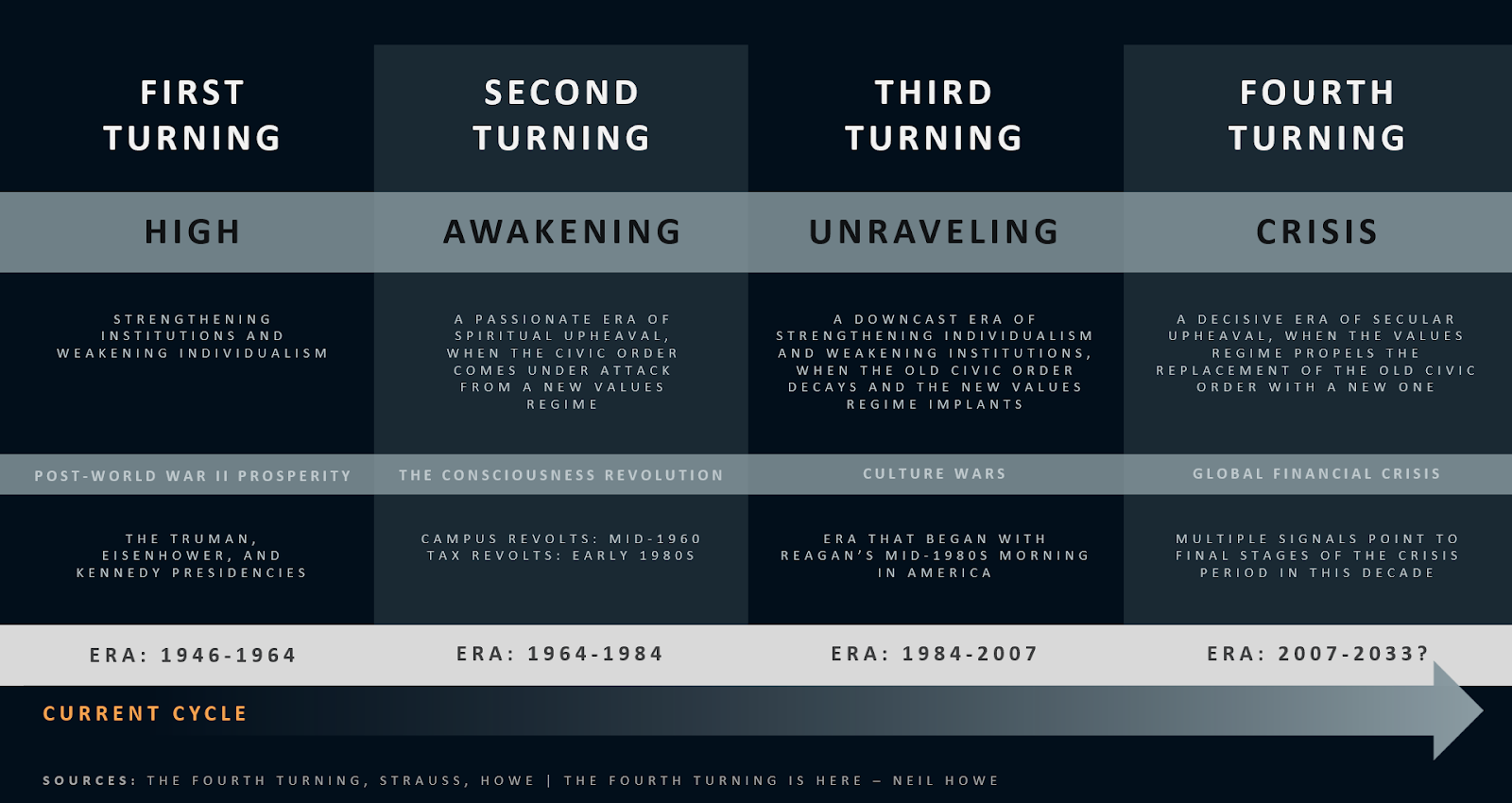
You may have heard financial doom mongers talking about the ‘Fourth Turning’. This is the final period of the four, denoting a decisive and turbulent era that resolves recent tensions and paves the way for expansion, strong institutions, and a collective purpose. We are currently in a fourth turning (started by the 2008 financial crisis). A bigger crisis looms large, and I think it has a lot to do with monetary policy.
What does all of this mean?
The outcomes of the societal shift we are currently experiencing lead to some bold predictions from the book’s authors, some of which are already in progress (remember, the book was written 30 years ago).
- The power of nation-states drastically weakens due to borderless digital economies and reduced powers of taxation. By 2024, about 25% of the global workforce was classified as gig‑workers.
- Welfare states collapse under fiscal strain, leading to a "welfare state death spiral."
Greece now uses 13% of government revenue to service interest on debt. Italy, Portugal, Spain, Ireland, and Canada all spend ≈10% of their budget paying back interest on loans. - The rise of the Sovereign Individual: people are protected by private security, cryptography, and global mobility. Digital defence being cheaper than an attack erodes monopolies on force. Competition and innovation thrive, while inequality rises as cognitive elites prosper. Ultimately, this is a more individualistic, libertarian society.
The book sums up its vision of digital money as follows:
“It will consist of encrypted sequences of multihundred‑digit prime numbers. Unique, anonymous, and verifiable, this money will accommodate the largest transactions. It will also be divisible into the tiniest fraction of value. It will be tradable at a keystroke in a multi‑trillion‑dollar wholesale market without borders.” The Sovereign Individual on money.
This is an accurate description of Bitcoin, published more than ten years before its discovery. It is the abilities of P2P cryptocurrency that make many of the book's predictions not only feasible, but a near certainty. The most important takeaway on Bitcoin is that it can help businesses, as well as individuals, become more sovereign.
***
How Bitcoin ties in with Sovereign Principles
Adopting Bitcoin means embracing "sound money" principles, echoing the book's call for opting out of coercive systems into voluntary, tech-enabled ones.
U.S. fiat currency (USD) loses ~2-7% value annually via inflation, eroding your business’s profits. Bitcoin's scarcity acts as a superior store of value, appreciating ~200% CAGR historically. SMBs can convert excess cash to Bitcoin, protecting against dollar debasement (e.g., amid $35T national debt). This strengthens balance sheets, enabling reinvestment without fiat's "silent tax."
Payment processors and banks charge 2-4% fees; Bitcoin transactions (via the Lightning Network) cost pennies. As a medium of exchange, Bitcoin cuts remittance costs for global suppliers/customers, vital for SMBs in trade, and guarantees no chargebacks or holds, reducing fraud risks.
Accepting Bitcoin taps a $2T+ market, attracting tech-savvy consumers (e.g., millennials/Gen-Z). Pricing select goods in BTC builds loyalty among bitcoiners, differentiating from competitors reliant on Visa/PayPal. In a digital economy, this also globalizes American SMBs without forex hassles.
Small businesses face SBA loans, IRS audits, and bank deplatforming (e.g., for "high-risk" industries). Bitcoin decentralizes finance, reducing reliance on centralized systems prone to censorship (e.g., Operation Choke Point 2.0).
Finally, during recessions or supply shocks, Bitcoin's liquidity and 24/7 access outperform frozen bank accounts. SMBs holding Bitcoin treasuries (as Tesla did) can borrow against it at low rates, fueling growth without dilutive equity.
Overall, Bitcoin adoption boosts competitiveness: A 2023 Deloitte survey shows crypto-friendly firms see 20-30% revenue lifts from new demographics. In a high-debt U.S., fiat-dependent SMBs risk failure, bitcoiners thrive.
***
Becoming a Sovereign Business
In 2025, U.S. small‑business owners can apply the core ideas from The Sovereign Individual to protect the interests of their business. These steps don’t apply to all business types in the same way, but taking the steps you can offers greater resilience, lower fixed costs, new revenue opportunities, and competitive differentiation.
The company name Sovreign (pronounced "sovereign") derives from the word sovereign, but spelled without the first ‘E’ so that it is a unique brand name while maintaining the same pronunciation as sovereign.

Go digital‑first
Shifting core operations to cloud‑based tools so the business isn’t tied to a physical location offers greater flexibility and lowers overheads. Use SaaS accounting, CRM, and project management platforms. Host the website/e‑commerce on a CDN‑enabled platform (Shopify, Squarespace). Adopt VoIP or virtual phone numbers for customer service, enabling remote work. Using privacy-focused services like Proton Suite can reduce reliance on Big Tech companies (Google, Apple, etc.)
Diversify income streams and accepted currencies
Adding multiple payment options, including Bitcoin, widens your customer base. Some businesses may be able to offer customer loyalty, subscription, or membership tiers to smooth cash flow. By keeping reserves in Bitcoin, businesses have a high‑yield online savings account with quick liquidity access.
Leverage network effects and community building
Positioning the business as a hub within a niche ecosystem rather than a solitary entity helps to strengthen revenue. The network of Square sellers accepting Bitcoin is one example of a helpful network. Building SMB and customer communities can offer access to niche expertise and tools while reducing reliance on local and state government infrastructure.
***
Small Sovereign Businesses in Action
The majority of America’s 36 million SMBs are single-person, increasingly digital businesses. For that reason, I thought it best to offer two examples of sovereign businesses—one digital and one physical.
The Indie-hacker
Pieter Levels is the solo‑founder behind Nomad List, Remote OK, Indie Hackers, Photo AI, and a handful of other sites. Through using a host of digital tools for product, marketing, and engineering, he runs everything himself, dramatically lowering overheads. And by using automation and open‑source tooling, Levels builds custom scripts to scrape data, generate newsletters, and handle payments, turning routine work into “digital assets” that run unattended.
His businesses are location independent as Pieter travels continuously, working from cafés, co‑working spaces, or a van, proving that a business can thrive without a fixed headquarters.
Finally, his sites accept payments via Stripe, PayPal, and Bitcoin, letting him capture revenue from a global audience without a single bank account. Running a fully monetized suite of sites without a team or outside investment allows this entrepreneur full sovereignty to make the best business decisions for his lifestyle and needs.
The Energy Sovereign
On the physical business side of the equation is Harold Tan, a seasoned entrepreneur with over a decade of experience in the Bitcoin and renewable energy sectors.
Through meshing his diverse skills in finance, energy, and Bitcoin, Tan has created a strong sovereign business as the co-founder of GigaWatt Inc, specializing in distributing and installing residential and portable solar power systems.
Renewable energy is a competitive sector, requiring strong ties to a host of centralized systems (energy regulators, government institutions, banks, etc). However, by understanding that Bitcoin mining can cut the time to ROI on solar facilities from 8.1 to 3.5 years, Tan helps customers become more sovereign themselves, reducing their reliance on energy grids.
“I entered the solar industry because it operationalizes sovereignty. Energy is the base layer of every economy. When individuals and small businesses can generate their own power and convert excess energy into a neutral, global asset like Bitcoin, they regain control over costs, capital, and risk. That shift—from dependency to ownership—is the core insight of The Sovereign Individual, applied in the real world.” Harold Tan, Director, Partner & Board Member, GigaWatt Inc
GigaWatt Inc applies sovereign principles by decentralizing energy production and improving capital efficiency at the edge. Its residential, portable, and modular solar systems reduce dependence on centralized utilities, regulatory bottlenecks, and fragile grid infrastructure. Customers move from being price-takers to owners of productive energy assets.
Bitcoin is treated as infrastructure, not speculation. By integrating optional Bitcoin mining, GigaWatt enables excess energy to be monetized on demand, materially shortening time-to-ROI and converting energy from a fixed cost into a revenue-generating asset. This aligns directly with Davidson and Rees-Mogg’s prediction that cryptographic systems would allow individuals to defend and grow economic value outside centralized monetary control.
At the governance level, GigaWatt prioritizes durability over scale: disciplined capital allocation, minimal leverage, and long-term ownership. As a partner and board member, Tan helps guide strategy around energy monetization, Bitcoin integration, and resilience. The result is a physical-world Small Sovereign Business—locally grounded, digitally enabled, and positioned for an increasingly decentralized economy.
Now, as a TEDx speaker, academic instructor, and Sovreign consultant, Tan has dedicated himself to educating business leaders, institutions, and students on disruptive technologies, particularly focusing on Bitcoin’s evolution and its impact on global finance.
Become a Small Sovereign Business Today
There are many steps you can take to reduce reliance on any single institution or location, unlock new revenue channels, and position your business to thrive in the increasingly digital, decentralized economy described in The Sovereign Individual. At Sovreign, we are experts in how small businesses can adopt and use Bitcoin to increase sovereignty. Here are the first steps you can take to do that:
- Educate stakeholders: Read The Sovereign Individual alongside Bitcoin resources like The Bitcoin Standard. After auditing finances to calculate fiat erosion (e.g., 22% loss over 5 years at 5% inflation), consider allocating a 5-10% Bitcoin treasury.
- Secure infrastructure: Embody sovereignty with non-custodial tools. Use multisig wallets for business funds and use self-custodial Lightning wallets. Train staff on basics, ensuring compliance (e.g., reporting BTC gains per IRS rules, but minimizing exposure).
- Integrate Bitcoin for payments: Accept Bitcoin via processors like Square (PoS) or BTCPay Server (free, open-source ePoS). For international payments, use Bitcoin to bypass SWIFT delays/fees.
- Think in Bitcoin: Track profit and loss in Bitcoin terms to internalize its stability, reducing forex risks. Consider lending rather than selling Bitcoin if you need to raise capital for your business.
- Scale and network: Join Bitcoin communities (e.g., Meetups, conferences, Nostr, X, merchant communities) to grow partnerships and a loyal customer base.
- Apply the sovereign mindset: Take your learnings from how Bitcoin offers sovereignty and apply it to other areas of your business—storage, tools, avoiding oversight, ownership of data, and location independence.
By 2030, as the book predicts, cybercurrencies will dominate commerce. Early adopters like Small Sovereign Business owners will lead the way, turning businesses into fortified, flourishing nodes in a decentralized world.
Start today, and avoid the traps of broken money and governments that throttle your independence.