Finding the Common Denominator


Measuring Value Against What?
If you’ve read this column before, you’ll notice a theme emerging — meals, provisions, sustenance, refreshments… food.
We all have to eat, and I believe the challenges small businesses face can often be solved by breaking bread together and feeding the mind with quality nutrition. Or maybe writing makes me hungry. Who knows?
I often think of ideas for this column while grabbing a bite, and it’s not just because I have time to think. Habitual purchases like groceries, gas, coffee, and lunch are a daily touchpoint of value assessment. I recently ate at Five Guys and noticed a significant price increase. The hamburger was $15, which I remember buying for less than $11 a couple of years ago. “Of course,” you say, “things get more expensive.” But price increases can outpace inflation.
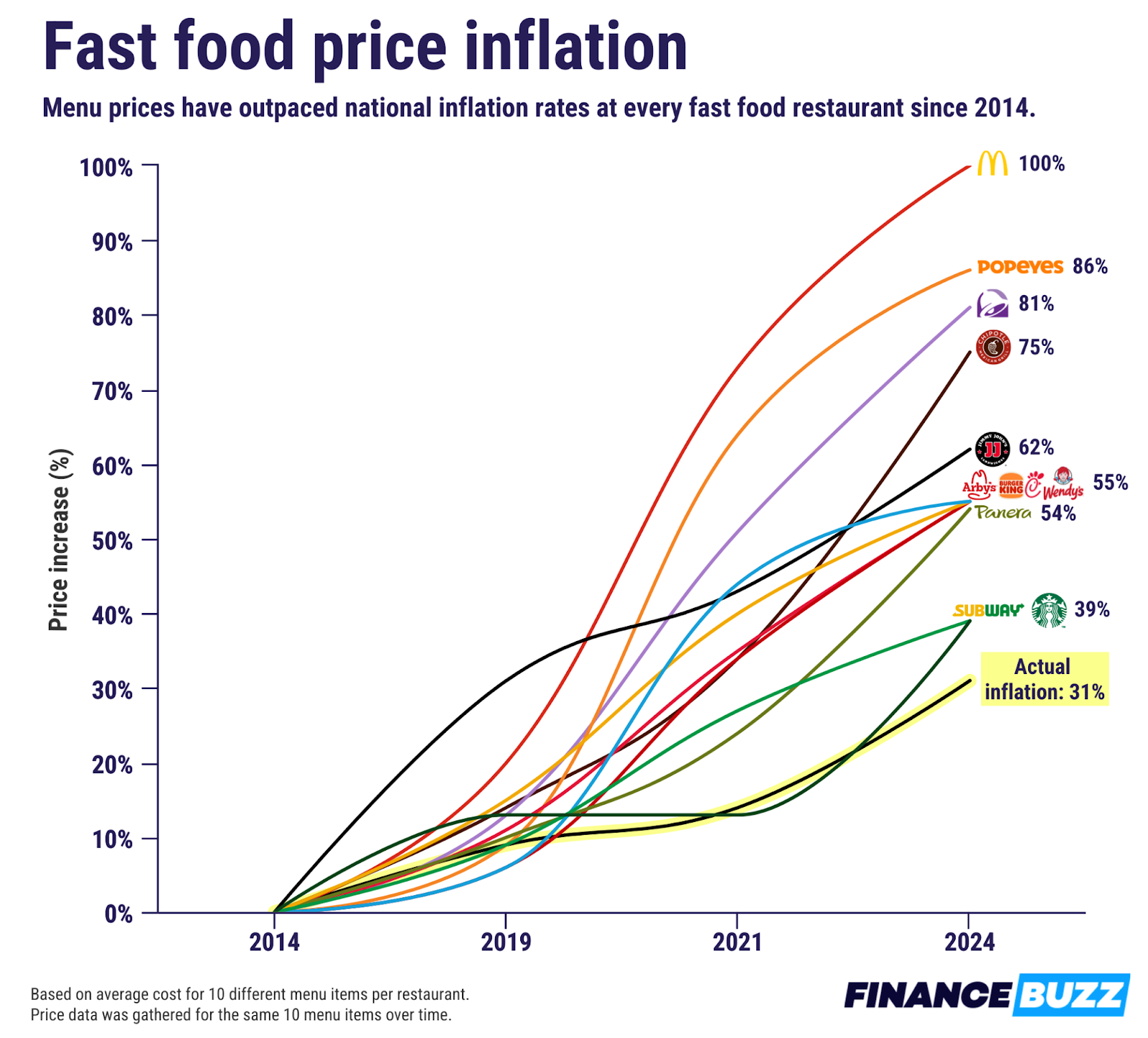
As a small business owner, I’m sure you’ll know that the Consumer Price Index (inflation measured with a basket of everyday goods) is not a good measure of change. Not all the goods we consume come in half-gallon bottles or two-pound packs. The price rises from the fast food restaurants are likely to have come from rising healthcare prices for employees, gas-price volatility, supply-chain issues with cooking oil, and a variety of other costs not included in CPI.
Worryingly, this chart comes from an article called “Fast food inflation: Which chains are hiking their prices the most?” It’s tempting to think that chains are gouging customers, but almost all of the brands pictured have reported a profit slowdown in the last few years. Consumers are feeling the pinch because of a broken monetary system, not because of corporate greed.
Businesses simply cannot keep prices in line with real costs. Raising the price of a milkshake by 2 cents every day would confuse customers who are used to inflation being absorbed, delayed, or hidden. Plus, inflation causes even bigger problems for small businesses. There is no leeway to continue operating a loss leader to show clients value. How many businesses can honestly say they increased the margin in real terms on one of their products without improving it?
If businesses attempt to increase real-term prices and not value, they lose customers. Simple.
In a world of shifting prices and dollar numbers constantly increasing, it can be extremely difficult to maintain a balanced view of how your business is actually faring.
However, there is one simple trick to better understand the value you offer customers and the health of your revenue and profit.
By using a new measuring stick, you’ll be able to see the bird’s-eye picture of your accounts clearly.
***
More Than One Way to Measure Value
In the introduction, I told you about the price changes at Five Guys. We compare value in dollars. It would be weird to measure the price rise of a New York burger using Vietnamese Dong, soybean futures, or Manhattan real estate values, right?
Previously, it was easier to use dollars as a measure of value. Things didn’t change all that much. Let’s look at the data: $100 in 1918 offered the same purchasing power as $115.89 in 1925. That’s 2.1% yearly inflation over the course of seven years. $100 in 2018 was worth $128.96 in 2025 (3.7% yearly inflation). Prices have to adjust much faster, and of course, many assets and commodities have inflated at a much higher rate than everyday items.
What about stocks? Well, between 1918 and 1925, investing $100 in the S&P 500 would have returned 7.1% annually. Between 2018 and 2025, you would have more than doubled your money (an 11.8% annual return).
But just because you live in the US doesn’t mean you must think in dollar terms. Measurements change based on the denominator you use as a baseline. Let’s look at the long-term view of the celebrated ‘investment vehicle’ of the S&P 500.
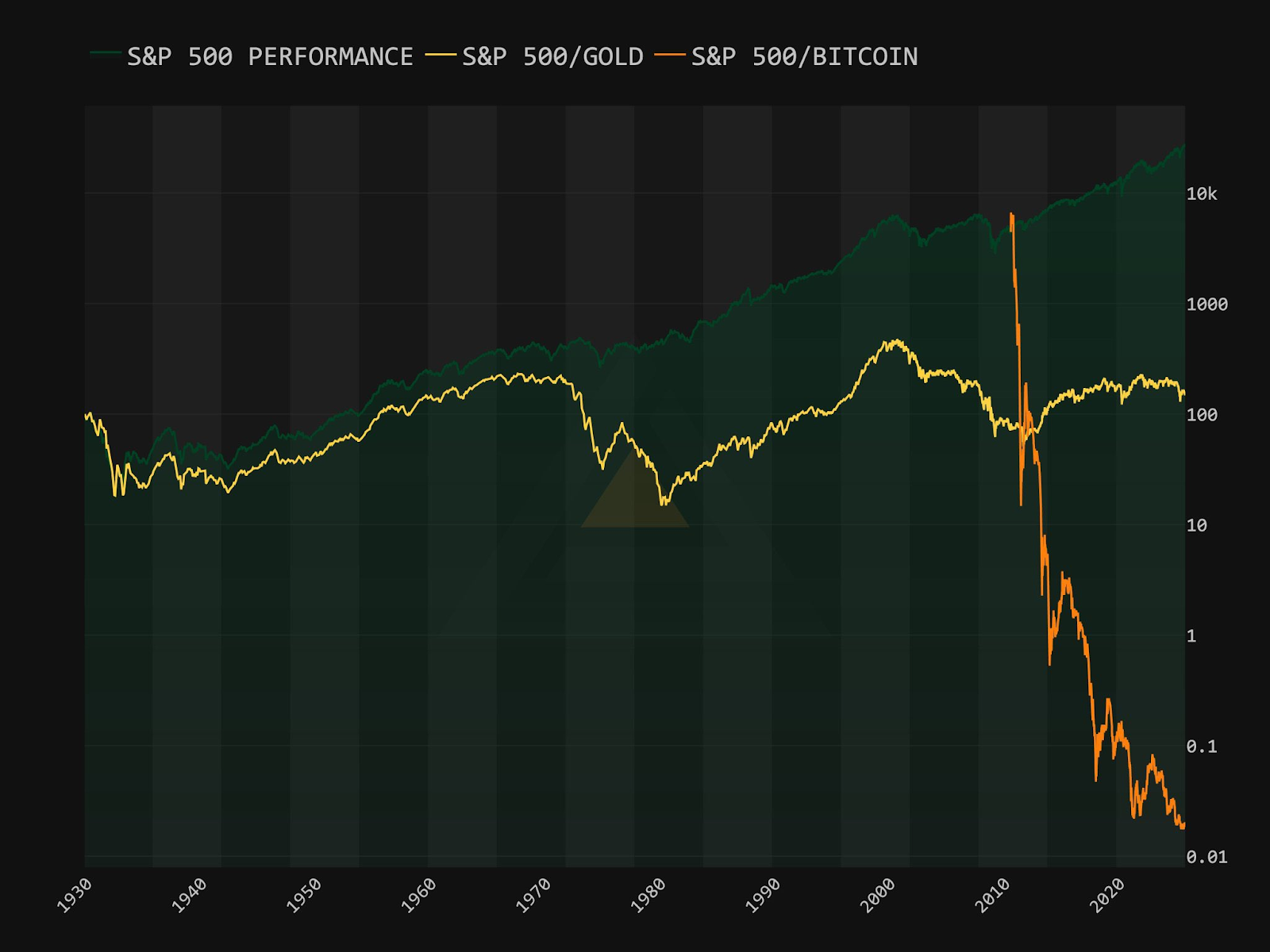
Against the dollar, stocks show a steady rise over the course of a century. A good way to protect your wealth, right?
Well, it’s certainly superior to cash. But versus gold, not so much. In fact, the S&P hasn’t risen in comparison to gold in over 100 years!
The S&P measured against Bitcoin tells a very different story. Yes, Bitcoin is a new technology, now classified as an asset by many institutions, but there is no comparison here. The S&P has absolutely tanked in value versus Bitcoin.
The point is not to call your broker and sell your portfolio immediately; it’s that using dollars as our measuring stick leads us to thinking short-term. All we can do is try to keep up with changing dollar values and run faster to earn more. Think of MSNBC or Bloomberg’s constant ticker and price rises and falls. It’s all about acting quickly and taking advantage of in-the-moment changes based on global events outside of your day-to-day life.
Many small businesses deal in hundreds or thousands of different goods. How much are eggs today? Should I buy fifty cases to lock in the price? What if they go bad? What if they are cheaper in a week? What about the oil to cook them in? What about new kitchen equipment?
It’s exhausting for SMBs to think this way. Scrambling to keep your head above water in the short term doesn’t offer the optionality and freedom you hope for when starting your own business. Prices going up is a constant headache.
We’ve talked about yearly inflation in dollar terms. But what does the Consumer Price Index chart look like when using Bitcoin as the denominator?
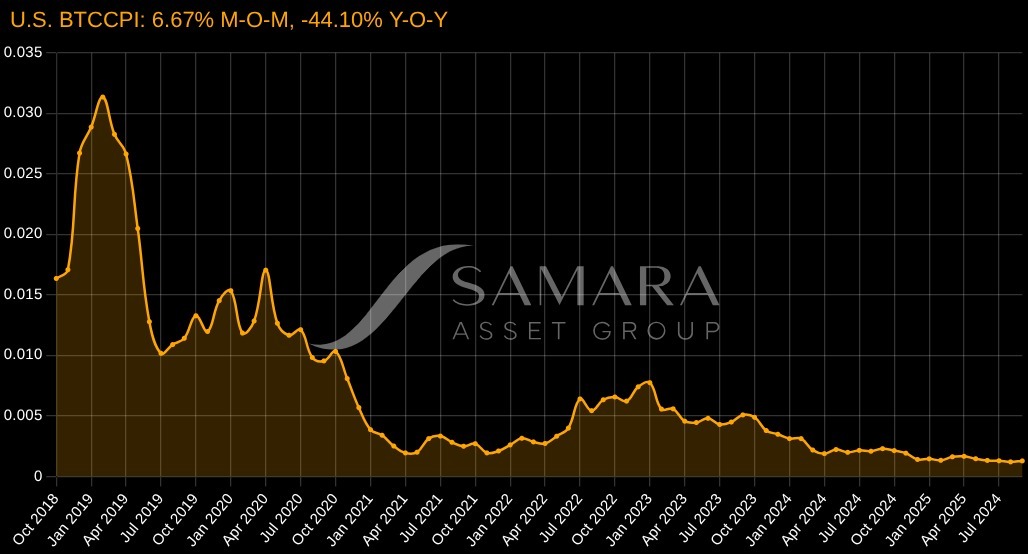
Over the last seven years, the typical basket of goods has reduced in cost by 44% YoY.
Would you be spending time worrying about egg prices, insurance premiums, or rising gas prices if you used Bitcoin?
“Everything is crashing in terms of Bitcoin.” Max Keiser
By zooming out and seeing the increase in purchasing power your business gains, you’d have time to focus on the projects you truly want to implement. You’d have more time for yourself and your family.
Due to its relatively low adoption rate (compared to dollars), few businesses price their goods in Bitcoin. For money to be used as a unit of account, it needs to hold a stable value in the short term and long term. As discussed in ‘A Tale of Two Businesses,’ Bitcoin’s long-term value is unparalleled, but in the short term, we do see changes much greater than that of a dollar. It would confuse customers if prices were only displayed in Bitcoin. One day, you might pay 3,000 sats for a frappuccino, and the next, 3,420.
But incredibly, services that charge in satoshis reduce their prices over time.
Trezor launched the world’s first hardware wallet in 2014, and the device was priced at 0.5 bitcoin. In 2025, the company launched the Safe7 device, which you can purchase for 0.0025 bitcoin.
Club Orange, a social app for Bitcoin events, sold lifetime memberships for 300,000 sats (0.03 bitcoin) upon launch in November 2022. This price has now been reduced to 100,000 sats in 2025 (the dollar price for subscription has increased in this time period).
In fact, deflationary money like Bitcoin shifts the incentives of businesses from providing cheap and flimsy products to ones that offer unparalleled quality and longevity. People will still need a car, they will still need to use the gym, and they will still need to eat. But with money that increases in purchasing power, they are incentivized to support businesses that they trust to deliver long-term value. They won’t want cheap, replaceable goods. If you’d like to read more about the positive effects of deflation, I highly recommend The Price of Tomorrow by Jeff Booth.
If in Doubt, Zoom Out
The unit bias of dollars makes us attempt to win short term. For example, I’m often asked about which cryptocurrency is ‘going to the moon’. People want to know which coin they can buy and sell quickly in order to get more dollars.
‘Crypto’ is completely unpredictable on a day-to-day basis. The only sure thing is that over longer time horizons, everything is crashing in relation to Bitcoin. In the last 12 months, XRP (Ripple) has seen a higher percentage increase in its dollar price than Bitcoin has. This leads a lot of people to ask if they should buy it instead of other assets (1 XRP token costs about $2, compared to Bitcoin’s $100,000). Put simply, they shouldn’t buy XRP. Ripple and its CEO, Brad Garlinghouse, are bad actors who actively spread misinformation, lobby against Bitcoin, and support the implementation of Central Bank Digital Currencies (CBDCs). Their token is designed to make a centralized group of early holders richer, and the blockchain offers no additional utility to Bitcoin. It’s speculation, pure and simple.
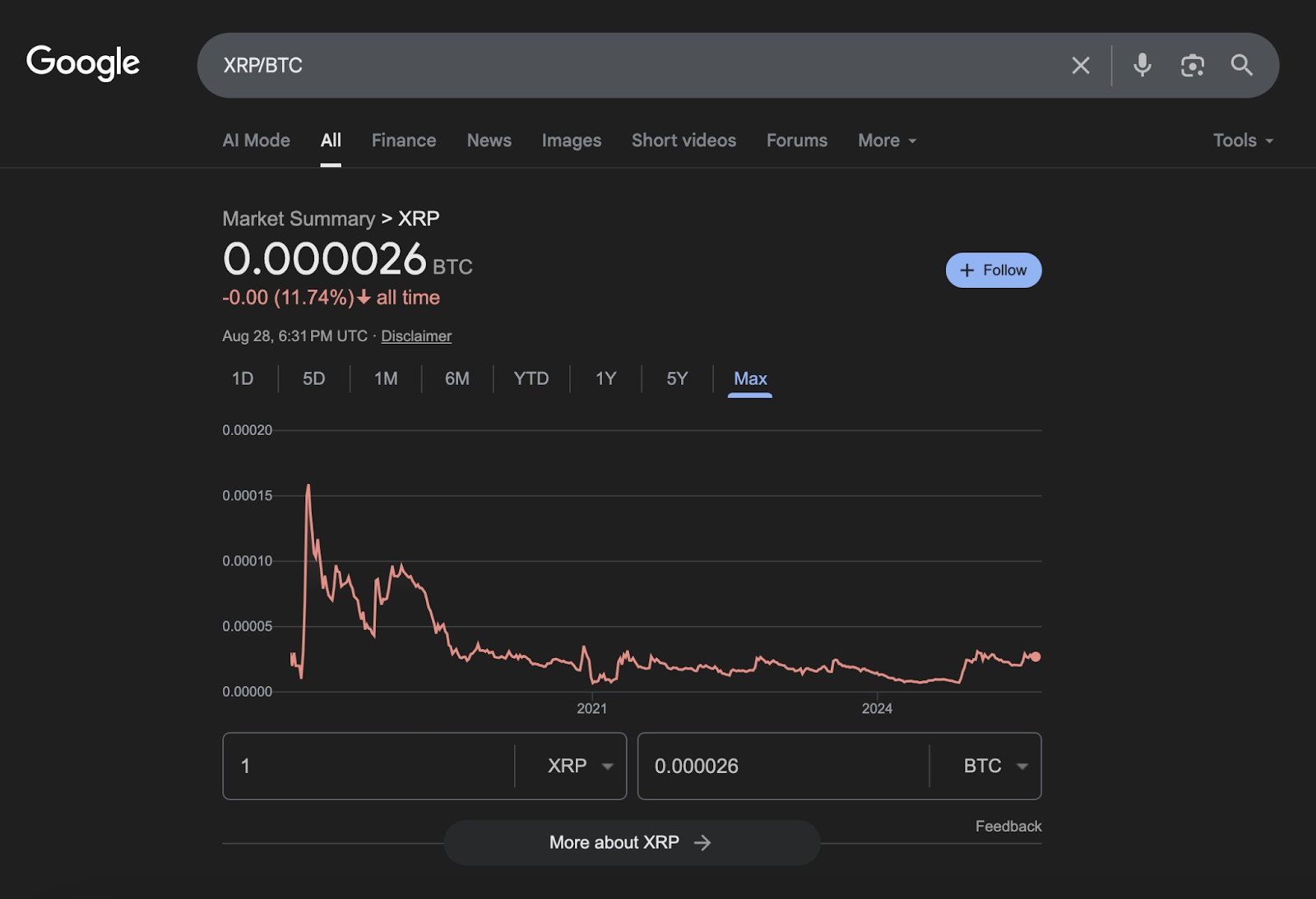
Winning for individuals and small businesses is not about timing the market. It’s about switching to the long view of Bitcoin as the denominator. As we can see, when you do that with XRP, it’s crashing in terms of Bitcoin.
With that said, we live in a dollarized world. We can’t switch all of our charts and price tags just yet. But the good thing about denominators is that you can change them. For example, your business can accept both BTC and USD (see Steak ‘n Shake’s story). Then, while saving the Bitcoin, over 3+ years, the dollar value will increase.
Business owners need several tools to measure the success of their companies. Impressing your peers at a local business owners' association isn’t as easy as saying ‘revenue increased by 18% this year’. What about profits? What about customer retention? What about upgrading your facility and future-proofing your business? What about your own personal goals?
One of the tools I recommend is to think of Bitcoin as a measuring stick or ruler.
If you don’t own any (or don’t accept Bitcoin payments), you’re not even on the board. You’re not able to capture the increases in purchasing power or use Bitcoin to measure your real-term metrics. As Samsom Mow says, ‘You either have sats, or you don’t.’
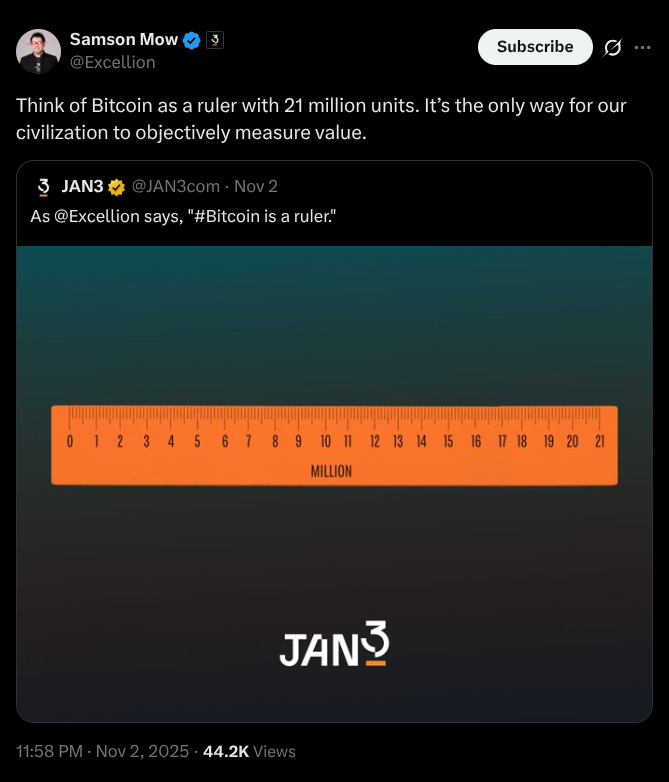
If the goal posts for money keep moving, how can you measure success? On the other hand, if our collective measure for value is fixed to 21 million units (unlike the dollar), then Bitcoin will work as a stable unit of account.
American SMBs need to be versatile to survive in 2026. They need to use different tools, adopt multiple strategies, and speak the language of several different customer types. My advice for small businesses, no matter the industry, would be to get on the board and start using the 21 million ruler to your advantage.
If, for example, your business accepts BTC on your Square terminal and you save 10% of your sales collected in BTC, now there’s at least a fixed amount of Bitcoin on your balance sheet, whatever your stack size is relative to the limit of 21M BTC total.
Conclusion
Most people have never thought about what money is. Unfortunately, it isn’t something we are taught at school. Most people would point to a green bill featuring Andrew Jackson or Benjamin Franklin and say, ‘That’s money!’ But, as Robert Breedlove regularly points out in his excellent column, money is a philosophical question.
As you can see from the previous articles about using Bitcoin on the balance sheet and as a payment technology, different aspects of money are all interconnected. SMBs can choose to see dollars, gold, Bitcoin, or any form of money as a store of value, a medium of exchange, a unit of account, or any combination of the three. There are many strategies that can benefit your business when it comes to how you deal with money.
For me, though, the key is being able to view the whole equation. Money is not one simple number on a computer screen or bill in your cash register. Wise business owners choose to store value in the most optimal way, they move with changing customer demands, and they work towards the long-term goals that bring them greater freedom.
In my opinion, SMBs that save in Bitcoin will win. Why? Because now you have money that will never be diluted. Once you’re on the board, you can start using the right ruler to measure your success.
Being able to switch your unit of account (denominator), at least in your own thinking, can be a superpower and a differentiator. Any SMB owner who's getting started with accepting and saving in Bitcoin is now thinking in two currencies and thus two denominators.
While you might be happy to see the purchasing power of your business increase in dollar terms, your customer (e.g., me, ordering a hamburger from Five Guys) would like to see the price reduce. Seeing the price go down in sats and the product staying the same sure would keep me coming back.
So let’s junk the broken standard and think differently.
When will you be ready to switch your denominator?
Also published on Substack:
https://jeffnewmanbtcyn.substack.com/p/finding-the-common-denominator